

Running a small business today means competing in a digital marketplace where customers search online before making decisions.
If your business doesn’t appear in search results, potential customers may never discover your products or services.
That’s where SEO small business strategies come in.
Search Engine Optimization (SEO) helps your website appear in search results when people look for products or services like yours. With the right approach, SEO can bring consistent traffic, leads, and customers—without paying for ads every day.
This guide explains SEO for small businesses in simple terms, including practical strategies that many competitor articles overlook.
What Is SEO for Small Business?
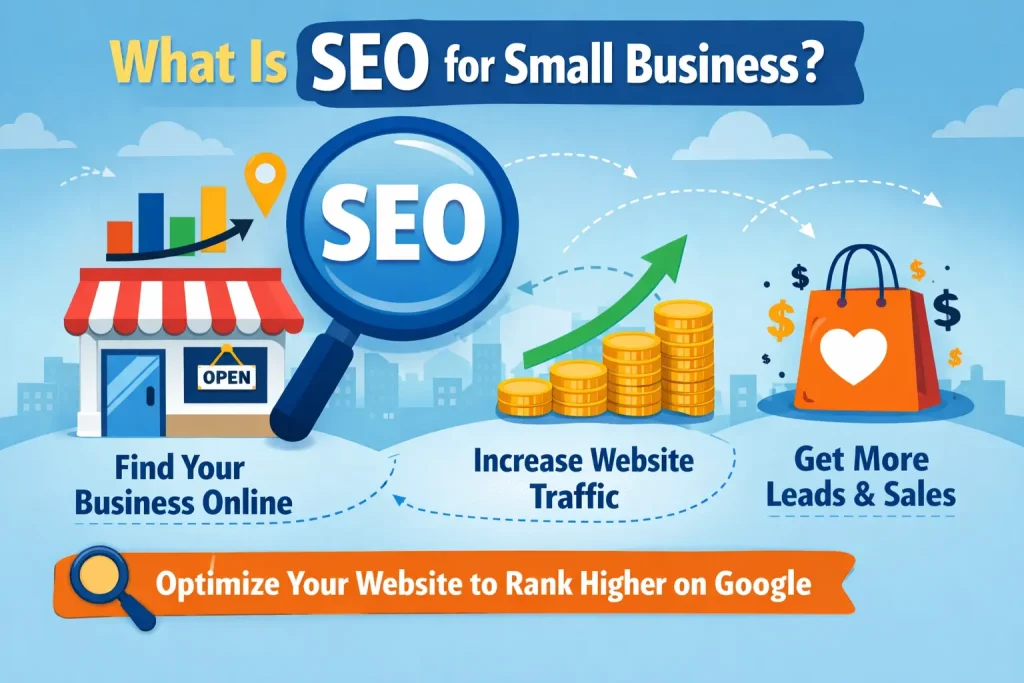
SEO small business refers to optimizing a small company’s website so it ranks higher in search engines like Google.
The goal is simple:
- Help potential customers find your business online
- Increase organic website traffic
- Generate leads and sales without relying solely on ads
When someone searches for a service like “local plumber near me” or “best bakery in town,” SEO helps your business appear in those results.
For small businesses, SEO is powerful because it allows you to compete with larger companies—even with a smaller marketing budget.
Why SEO Is Important for Small Businesses
Small businesses often rely on visibility and trust. SEO helps build both.
Here are some key benefits.
More Website Traffic
Ranking on Google’s first page dramatically increases clicks and visits to your website.
Higher Credibility
Users trust businesses that appear in top search results.
Cost-Effective Marketing
Unlike paid advertising, SEO continues generating traffic over time.
Local Customer Growth
Local SEO helps people in your area find your business quickly.
Long-Term Business Growth
Strong SEO creates sustainable online visibility for years.
How Search Engines Work
Search engines like Google use automated programs called crawlers to scan the internet.
These crawlers:
- Discover web pages
- Analyze content and keywords
- Evaluate quality and authority
- Rank pages based on relevance
When someone searches for information, Google shows the pages it believes provide the most helpful answers.
To rank higher, your website must show search engines that it offers valuable, trustworthy, and relevant content.
Essential SEO Strategies for Small Businesses
To succeed with SEO, small businesses should focus on a few core strategies.
Keyword Research
Keyword research identifies what people are searching for online.
For example:
- seo small business
- small business SEO strategy
- local SEO for small businesses
- SEO tips for small companies
Using the right keywords helps search engines understand your content.
Tips for Better Keyword Research
- Focus on long-tail keywords
- Target questions customers ask
- Use tools like keyword planners or SEO software
- Analyze competitors’ keywords
Long-tail keywords often bring more targeted traffic and lower competition.
On-Page SEO Optimization
On-page SEO involves optimizing the content and structure of your website.
Important elements include:
- Title tags
- Meta descriptions
- Headings (H1, H2, H3)
- Image alt text
- Internal links
- Keyword placement
A well-structured page helps both users and search engines understand your content.
High-Quality Content Creation
Content is one of the most powerful SEO tools.
Helpful content should:
- Answer real customer questions
- Provide clear solutions
- Include examples or tips
- Be easy to read and well structured
For example, a local bakery might publish content such as:
- “How to Choose the Perfect Birthday Cake”
- “Best Wedding Cake Trends This Year”
This type of content attracts search traffic and builds trust.
Local SEO for Small Businesses
Local SEO is especially important for businesses that serve a specific area.
Optimizing for local search helps customers nearby find your services.
Local SEO Tips
- Create a Google Business Profile
- Add accurate contact information
- Encourage customer reviews
- List your business in online directories
- Use location-based keywords
Local SEO can dramatically increase foot traffic and local leads.
Building High-Quality Backlinks
Backlinks are links from other websites pointing to your site.
Search engines treat backlinks as votes of confidence.
Strong backlinks signal that your website is trustworthy.
Examples of good backlink sources:
- Local news websites
- Industry blogs
- Business directories
- Partnerships with other businesses
Quality matters far more than quantity.
Technical SEO Basics
Technical SEO ensures that your website functions properly and loads quickly.
Important technical factors include:
- Mobile-friendly design
- Fast page speed
- Secure HTTPS connection
- Clean site structure
- Easy navigation
Technical improvements enhance user experience and search rankings.
SEO Tools That Help Small Businesses
Many tools simplify SEO tasks.
Popular tools include:
- Google Analytics
- Google Search Console
- Ahrefs
- SEMrush
- Moz
These tools help track:
- website traffic
- keyword rankings
- backlinks
- user behavior
Monitoring these metrics helps improve your SEO strategy.
How AI Is Changing Small Business SEO
Search is evolving due to artificial intelligence.
Modern SEO now includes concepts such as:
Generative Engine Optimization (GEO)
Optimizing content so AI tools can summarize and cite your website.
Answer Engine Optimization (AEO)
Structuring content to answer questions clearly for voice assistants and search snippets.
AI Optimization (AIO)
Ensuring content is readable and understandable for AI systems and algorithms.
To adapt to AI search:
- Write clear answers to common questions
- Use structured headings
- Provide unique insights or data
- Focus on helpful content rather than keyword stuffing
Step-by-Step SEO Strategy for Small Businesses
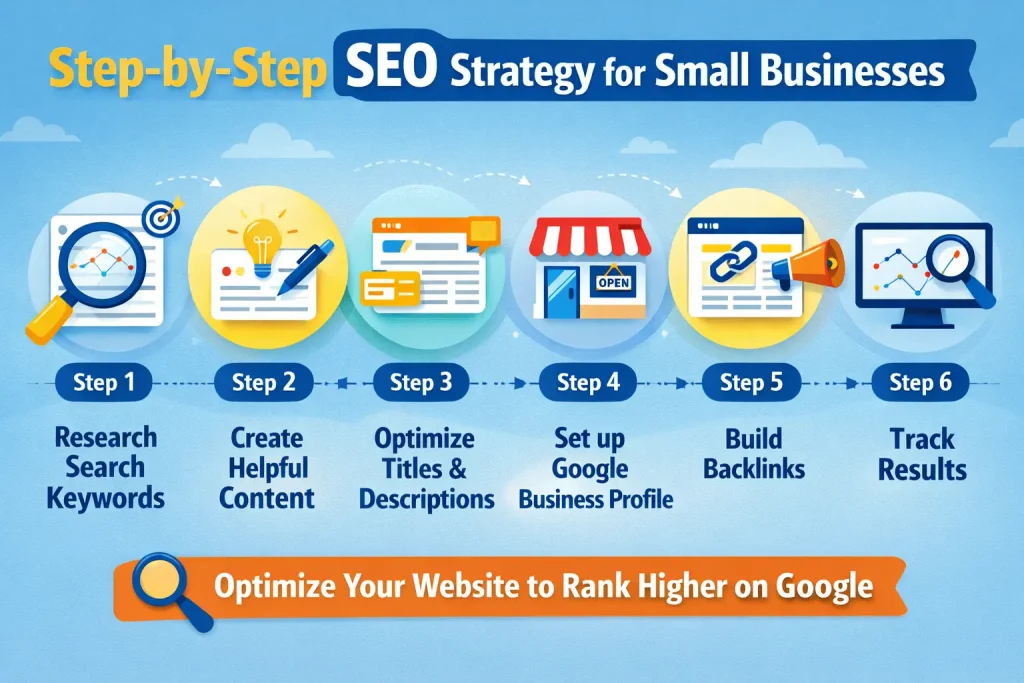
Here is a simple roadmap small businesses can follow.
Step 1
Research customer search keywords.
Step 2
Create helpful website content.
Step 3
Optimize titles, headings, and descriptions.
Step 4
Set up Google Business Profile.
Step 5
Build backlinks from trusted sources.
Step 6
Track results with SEO tools.
SEO is a long-term strategy, so consistency is key.
Common SEO Mistakes Small Businesses Should Avoid
Many businesses struggle with SEO because of common mistakes.
Avoid these pitfalls:
- Keyword stuffing
- Ignoring mobile optimization
- Publishing low-quality content
- Buying spammy backlinks
- Neglecting local SEO
- Not updating old content
Fixing these issues can significantly improve rankings.
SEO Checklist for Small Businesses
Use this simple checklist to improve your SEO performance.
- Research keywords before writing content
- Optimize page titles and meta descriptions
- Publish helpful and original content
- Improve website loading speed
- Ensure mobile responsiveness
- Build quality backlinks
- Encourage customer reviews
- Monitor performance regularly
Following this checklist helps build a strong SEO foundation.
Final Thoughts
SEO is one of the most powerful marketing strategies available to small businesses.
By optimizing your website, creating helpful content, and focusing on user experience, your business can attract more customers online.
Although SEO takes time, the long-term rewards are significant.
With the right SEO small business strategy, even a small company can compete with larger brands and grow steadily in the digital marketplace.
