
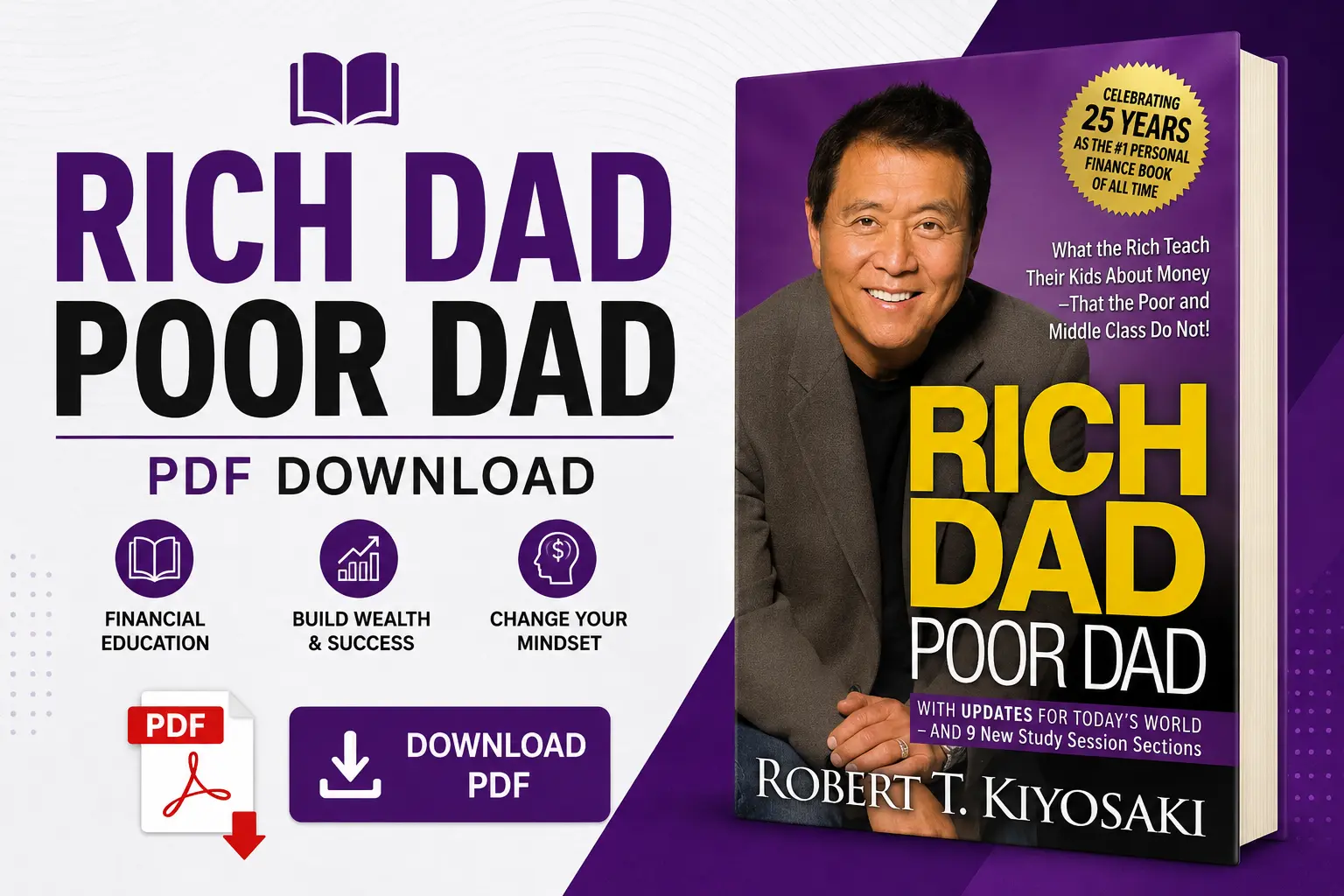
Rich Dad Poor Dad PDF
Read the PDF directly on this page. After reading, scroll down to continue the article.
If you’ve ever Googled “Rich Dad Poor Dad PDF,” you’re not alone. Millions of people search for this book every month — and for good reason. It’s one of the most talked-about personal finance books ever written.
This guide goes further. You’ll get the key lessons, honest critiques, actionable takeaways, and everything your competitors’ articles conveniently left out.
What Is Rich Dad Poor Dad?
Rich Dad Poor Dad is a personal finance book written by Robert T. Kiyosaki, first published in 1997. It has since sold over 40 million copies in more than 100 countries, making it one of the best-selling financial books of all time.
The book tells the story of two father figures in Kiyosaki’s life:
- Poor Dad — his biological father, a highly educated government employee who struggled financially
- Rich Dad — his best friend’s father, a businessman with little formal education who built significant wealth
Through their contrasting mindsets and advice, Kiyosaki explores why financial education matters more than academic education when it comes to building wealth.
Who Should Read This Book?
This book is ideal for:
- Beginners in personal finance who want a simple, story-driven introduction to money concepts
- Young adults entering the workforce for the first time
- Entrepreneurs looking to shift from an employee mindset to a business owner mindset
- Anyone feeling stuck in the paycheck-to-paycheck cycle
- Students who feel school never taught them how money actually works
If you already have advanced knowledge of investing, accounting, or business finance, you may find the book too introductory — but the mindset lessons still hold value.
The 6 Core Lessons From Rich Dad Poor Dad
Here are the most important ideas the book teaches, explained clearly:
Lesson 1: The Rich Don’t Work for Money — Money Works for Them
Most people trade their time for a paycheck. The wealthy, however, build systems and assets that generate income even while they sleep.
The key shift: stop asking “How do I earn more?” and start asking “How do I make my money earn more?”
Lesson 2: Financial Education Is the Real Asset
Kiyosaki argues that what you know about money is more valuable than how much money you have. Without financial literacy, even a large salary can disappear quickly.
Financial education includes understanding:
- How to read a financial statement
- The difference between assets and liabilities
- How taxes, inflation, and debt work
Lesson 3: Know the Difference Between Assets and Liabilities
This is one of the book’s most debated — and most useful — concepts.
- Assets put money into your pocket (rental properties, stocks, businesses)
- Liabilities take money out of your pocket (car loans, credit card debt, mortgages on personal homes)
Kiyosaki’s controversial claim: your house is not an asset — it’s a liability, because it costs you money every month rather than generating income.
Lesson 4: Mind Your Own Business
Kiyosaki encourages readers to keep their day job but also build their own asset column on the side. Your employer’s business builds wealth for your boss. You need to build wealth for yourself.
This means investing in:
- Real estate
- Stocks and dividend-paying securities
- Intellectual property (books, courses, patents)
- Small businesses
Lesson 5: Understand How Taxes and Corporations Work
The wealthy use legal corporate structures to reduce their tax burden. Kiyosaki explains that employees are taxed before they spend, while business owners can spend first and be taxed on what’s left.
This is not about tax evasion — it’s about understanding the rules of the financial system.
Lesson 6: Work to Learn, Not Just to Earn
Kiyosaki recommends taking jobs that teach you valuable skills — sales, marketing, accounting, leadership — rather than simply chasing the highest salary. A broad skillset makes you a stronger entrepreneur and investor over time.
What Most People Don’t Tell You (The Honest Breakdown)
Most summaries of this book are purely positive. Here’s what they leave out:
What the Book Gets Right
- It democratizes financial thinking in a way that textbooks never do
- It challenges the “go to school, get a job, save money, retire” narrative — which genuinely doesn’t work for everyone
- It introduces concepts like passive income, asset building, and financial independence to readers who have never encountered them
- Its storytelling format makes complex ideas emotionally accessible
What the Book Gets Wrong (or Oversimplifies)
This is where most articles go silent. But if you’re going to apply these ideas to your real life, you need the full picture:
1. “Your house is a liability” is an oversimplification.
In many markets, homeownership has built significant wealth for middle-class families over decades. The truth is more nuanced — it depends on your market, mortgage terms, and financial situation.
2. The “Rich Dad” figure has never been verified.
Kiyosaki has been inconsistent about whether “Rich Dad” was a real person or a composite character. For a book built on personal narrative, that’s a meaningful credibility gap.
3. The advice can be risky without context.
Telling beginners to take on “good debt” and invest in real estate without explaining risk management, market cycles, or due diligence can lead to poor decisions.
4. It’s light on actionable steps.
The book is excellent at changing how you think about money but gives very little concrete guidance on exactly what to do. It often leads readers to Kiyosaki’s paid courses and seminars for the “how.”
5. “Savers are losers” is dangerous advice for some.
For people in debt, with no emergency fund, or in unstable financial situations, building savings is still the responsible first step — regardless of inflation.
Key Takeaways You Can Actually Use Today
Don’t just read — act. Here are concrete steps inspired by the book’s best ideas:
Track your money
Write down every asset and liability you currently own. Be honest.
Buy one income-producing asset this year
It doesn’t have to be a rental property — it could be dividend stocks, a digital product, or a side business.
Learn one financial skill
Start with basic accounting or take a free investing course online.
Read your pay stub
Understand how much of your income goes to taxes and where it goes.
Reinvest before you spend
Automate a portion of your income into investments before lifestyle expenses take it.
Build a financial team
The book recommends surrounding yourself with a good accountant, lawyer, and financial advisor — not doing everything alone.
About the Rich Dad Poor Dad PDF
Many people search for the Rich Dad Poor Dad PDF to access the book’s content quickly and for free. Here’s what you should know:
- The book is copyrighted. Unauthorized PDF versions circulating online are illegal copies. Downloading them violates copyright law and deprives the author of rightful income.
- Legal formats are widely available. You can access the book through Amazon Kindle, Google Play Books, Apple Books, or borrow it through your local library or apps like Libby.
- The official Rich Dad website (richdad.com) offers free resources, articles, tools, and even a free investing game (CASHFLOW Classic) that reflects the book’s core ideas.
Rich Dad Poor Dad vs. Other Personal Finance Books
Wondering how it stacks up against other popular reads? Here’s a quick comparison:
| Book | Best For | Focus |
|---|---|---|
| Rich Dad Poor Dad | Mindset shift beginners | Assets, passive income, financial education |
| The Total Money Makeover – Dave Ramsey | Debt elimination | Budgeting, debt payoff, saving |
| The Millionaire Next Door | Data-driven readers | Frugality, wealth habits, research-backed |
| I Will Teach You to Be Rich – Ramit Sethi | Young professionals | Automation, investing, practical steps |
| The Psychology of Money – Morgan Housel | Behavioral finance readers | Money mindset, emotions, long-term thinking |
Each book has strengths. Rich Dad Poor Dad is best used as a mindset foundation, not a complete financial plan.
Final Verdict: Is Rich Dad Poor Dad Worth Reading in 2025?
Yes — with the right expectations.
If you go in knowing it’s a philosophy book, not a step-by-step investing manual, you’ll get enormous value. It will challenge assumptions you didn’t know you had and introduce you to a new vocabulary around wealth-building. Just don’t stop there. Pair it with more technical resources, speak with a licensed financial advisor, and always apply critical thinking before making real financial decisions.
The book won’t make you rich. But it might change the way you think — and that’s where wealth actually begins.
Frequently Asked Questions
Is the Rich Dad Poor Dad PDF free?
Unauthorized PDF versions are illegal. Use your public library, Kindle Unlimited, or purchase through official retailers.
How long does it take to read Rich Dad Poor Dad?
Most readers finish it in 4–6 hours. It’s written in an easy, conversational style.
Is Rich Dad Poor Dad good for beginners?
Yes. It’s one of the best entry points into personal finance precisely because it focuses on mindset over technical detail.
What is the main message of Rich Dad Poor Dad?
That financial education — not a high salary — is the foundation of lasting wealth.
Is Robert Kiyosaki’s advice reliable?
His mindset principles are widely respected. However, some of his specific financial predictions and investment claims have been controversial. Always verify advice with a licensed professional.
You May Also Like It:
How to Win Friends and Influence People PDF
